

마레아
Ma rea
Location : Gyeongju-si, Gyeongsangbuk-do
Program : Pool villa
Area : 118.91 m²
Structure : Reinforced concrete structure
Structure engineering : SDM Partners
Construction : 만불건설
Photographs : Yoon, joonhwan
Beyond Staying: Toward a New Competitiveness
The area around Gyeongju is already saturated with numerous hotels and pensions.
To gain competitiveness in such an environment, something distinctly different was required.
Popular pensions all share a clear, defining content—whether it is a pool, an emotional atmosphere, or exceptional scenery—each possesses its own unique appeal.
However, aside from the pool, most of these features are tied to the act of simply staying.
From this perspective, establishing a unique competitive edge meant shifting the focus from mere accommodation to the idea of play.
What is play?
Play is the joy and fun that emerge when multiple people engage together.
For the general public—most of whom live in apartments—there is a clear lack of opportunities for play within their living environments.
The limitations of what one can do in an apartment living room are obvious.
Experiencing wind-blown plants, touching soil, and the ways children develop by creating their own play—these are all things that highlight the essential importance of play.
Through kindergarten design projects, we learned how crucial these experiences are for children’s growth.
스테이에서 플레이로
경주 주변에는 여러 호텔들과 펜션들이 이미 포화상태인 것처럼 자리잡고 있다.
이런 상황에서 경쟁력을 가지기 위해서는 그들과 다른 무언가가 필요했다. 사람들이 많이 찾는 펜션들은 그 곳만의 분명한 컨텐츠가 있었다.
풀(POOL)이 있거나 감성적인 부분을 만족시켜준다거나 풍경이 좋거나 등의 자체적인 경쟁력을 나름 갖고 있는 곳들이었다. 그러나 이 모든 컨텐츠는 풀(POOL)을 제외하고는 머무는 성향에 기인하고 있었다.
이런 관점에서 이곳만의 경쟁력을 갖추기 위해서는 단순히 머물기만 하는 성격에서 놀이라는 관점으로 옮겨 생각해볼 필요가 있었다.
놀이란 무엇인가? 여러 사람이 어우러져 재미와 즐거움을 누리는 것이다. 아파트가 대부분을 차지하는 대중들은 거주공간 내에서의 놀이에 대한 결핍이 있다고 판단한다.
아파트 거실에서 할 수 있는 놀이의 한계는 명확하기 때문이다. 바람에 흔들리는 식물을 마주하고 흙을 만지는 경험, 여러 놀이를 스스로 하면서 발전해가는 아이들의 사고.
이것은 놀이가 아이들에게 얼마나 중요한 것인지를 유치원 설계를 통해서 알고 있었다.


Garden and Playground
A flat, open lawn often functions more as scenery than as a space for play.
From the perspective of children’s play, such a picturesque yard was unnecessary.
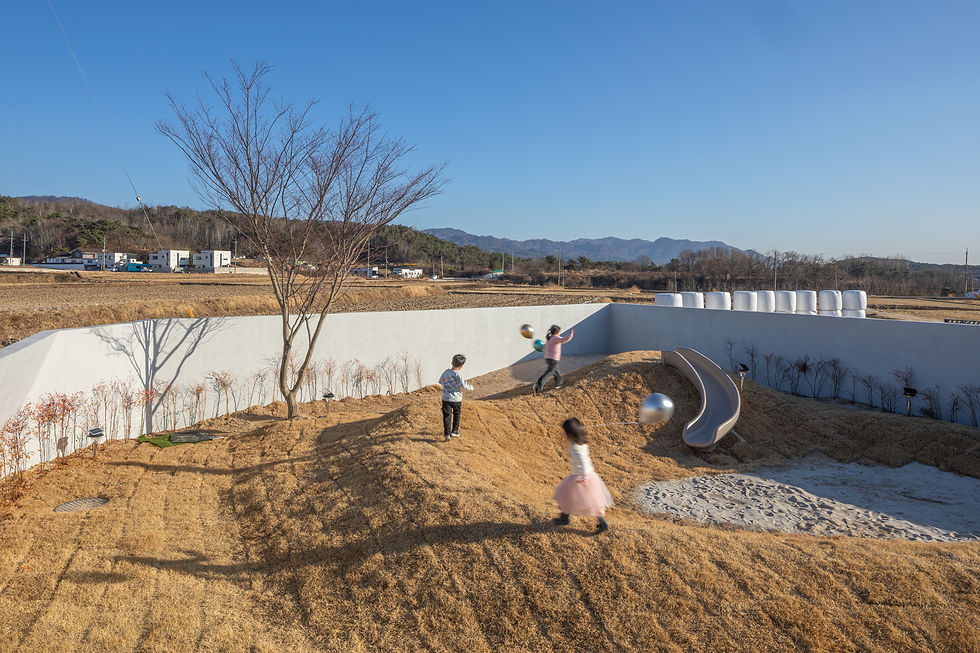
As demonstrated in the “Adventure Playground” experiment, children need nothing more than soil and gentle mounds to invent their own play.
However, designing the yard strictly as a playground risked making it less meaningful for guests without children.
This led to the idea of a yard design that dissolves the boundary between garden and playground.
Because mounds were essential, we shaped them in a donut-like ring that gently surrounds a central soil-play area.
From the pension, the yard appears to be a serene garden of green grass, while the soil play zone is nestled within the mounded form and remains visually unobtrusive.
This design choice was later affirmed through guest feedback.
Contrary to parents’ expectations that their children would spend most of their time in the pool villa, the kids played in the mounded yard until checkout.
Seeing this, many parents felt a mix of regret and guilt, realizing how rarely they had provided even a small yard for their children to freely enjoy.
정원과 놀이터
단순히 평평하게 펼쳐진 잔디마당은 놀이의 장소라기 보단 풍경의 장소로서의 의미가 더 높다고 생각했다.
놀이의 관점에서 풍경 같은 마당은 아이들에게 필요하지 않았다. 아이들에겐 그저 흙과 구릉만 있으면 어떤 놀이도 스스로 만들어서 놀 수 있다는 걸 기적의 놀이터 실험에서도 확인이 되었다.
그렇다고 놀이터 같은 마당을 만들려고 하니 아이들을 동반한 숙박객이 아닌 다른 숙박객들의 경우에는 이런 마당이 제대로 활용되지 못할 가능성이 농후했다. 그래서 이런 놀이터와 정원의 경계를 허문 마당 디자인을 구상했다.
구릉은 분명 필요한 요소였기에 흙 놀이의 공간을 에워싼 도넛 형태로 구릉을 만들었다. 펜션에서 마당을 바라보면 구릉 속에 흙놀이가 있었기에 푸른 잔디만 바라보게 되는 정원으로 보였다.
이 구릉에 대한 얘기는 숙박 객들의 후일담에서 충분히 들을 수 있었다. 풀빌라에서 재미있게 놀 거라고 생각한 부모들의 예상을 뒤엎고 구릉진 마당에서 아이들은 퇴실시간을 꽉 채울 때까지 놀았다.
그것을 본 부모들의 마음은 작은 마당하나 주지 못한 안타까움과 미안함으로 가득 찼다고 한다.

Service Satisfaction Relative to Room Rates
Higher room rates inevitably come with higher expectations for service satisfaction.
This satisfaction stems from both quality and thoughtful consideration.
While construction quality forms the fundamental baseline of luxury, what was needed here was a different kind of attentiveness.
A deep understanding of circulation flow, optimal room proportions, bed heights refined through real experience, inconveniences parents face when bathing children with a shower, children’s patterns of play—these layers of careful consideration were seen as essential factors that determine the quality of service.
Additionally, to accommodate guests who may feel burdened by high room rates, two rooms were positioned apart from each other, each with its own attached bathroom, allowing two families to stay comfortably together.
By enabling shared use at half the cost, the design provides flexibility for guests facing financial concerns while still maintaining comfort and quality.
객실단가에 따른 서비스의 만족도
높은 객실단가에 따른 서비스 만족도는 높을 수밖에 없다.
그것은 품질과 배려에서 비롯된다. 건축의 품질은 곧 고급의 기본적 기준이지만 다른 관점의 배려가 필요했다.
동선에 대한 깊은 이해와 최적의 공간 크기, 경험에서 비롯된 침대의 높이, 샤워기로 아이들을 목욜시킬 때 불편했던 것들, 아이들의 놀이패턴 등등 세심한 배려가 서비스의 질을 판가름할 요소라고 판단했다.
또한 높은 객실단가가 부담스러울 수 있는 고객들에 대한 배려로 방 두 개를 거리를 두고 배치하고 각 실에 욕실에 붙여두어 두 가족이 숙박해도 무방하게끔 계획했다.
절반의 비용으로 이용할 수 있기에 비용에 대한 부담스런 상황에 유연하게 대처할 수 있게 하였다.


The Diagonal Form
In this pension project, the diagonal line became a key architectural language.
Since the building was not intended to be an everyday space, we explored architectural elements that are uncommon in daily life—and from this inquiry emerged the idea of the diagonal wall.
Some of these walls blur the distinction between wall and roof, but their purpose was clear: to serve as symbols of the unconventional.
Thus, diagonal walls were adopted as a defining design element of the entire building.
The diagonal wall at the entrance leans to the right, reflecting an initial concept in which the adjacent plot would be developed as a continuous sequence of similar units.
Because multiple buildings in a row could appear too massive when perceived as a single volume, the diagonal walls were intended to visually break down the scale when viewed from the street.
However, by the time the structural frame was completed, the adjacent site had been sold, and this larger vision could no longer be realized.
사선의 형태
이 펜션에서 형태의 언어로 사선을 사용하였다. 일상적인 공간이 아니기에 일상에서 마주하기 어려운 건축의 요소는 무엇일까라는 고민 끝에 사선의 벽을 떠올렸다.
이것은 벽인가 지붕인가 구분하기 모호한 것도 있었지만 일반적이지 않은 것의 상징으로서 사선 벽을 전체 건물의 디자인 요소로 사용하였다.
입구의 사선벽체는 우측으로 뉘어져있는데 이는 옆 대지에 연속적으로 지어야하는 구상이 있었기 때문이다.
여러 채가 연속되는 형태였기에 한 필지에 한 개의 덩어리로 인식된다면 그 거대함이 자칫 부담스러울 수 있었기에 사선의 벽으로 나누어 거리에서 봤을 때 부담을 최소화 하고자 하였다.
그러나 골조공사가 마무리되는 시점에 이미 대지가 매매가 이루어지면서 그 구상은 허상이 되어버렸다.

Project Gallery


